Key takeaways:
Short cycling of an AC occurs when your air conditioner switches on and off too often without going through a normal cooling cycle. This guide covers:
- What AC short cycling is
- Common causes of AC short cycling
- What it means when an AC unit is humming but not turning on
- Whether short cycling can damage your AC
- How to prevent AC short cycling
- When to call an HVAC professional
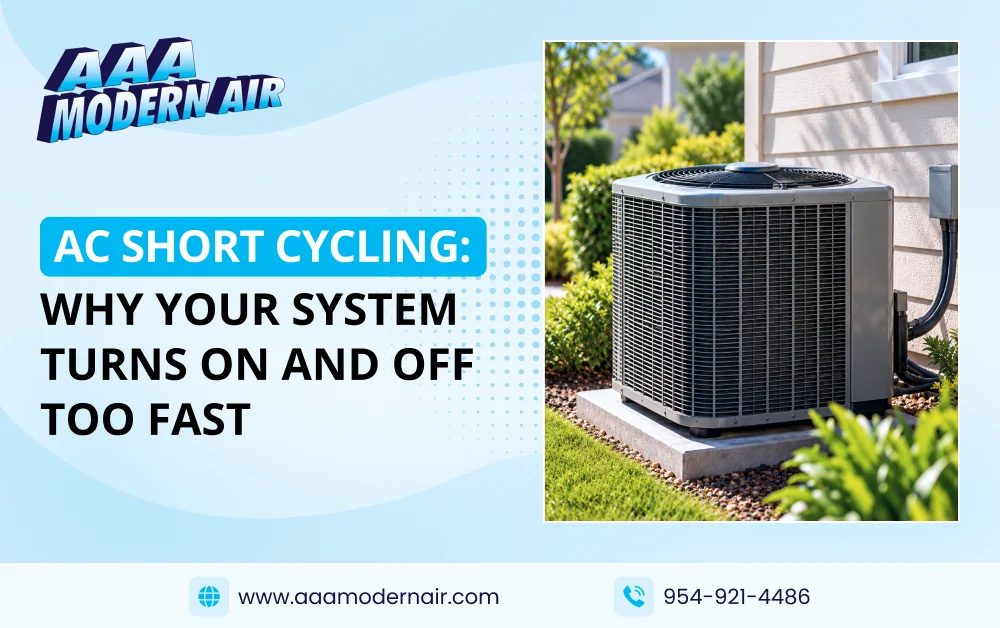
When your air conditioner continuously switches on and off every few minutes, there is a possibility of it being afflicted by AC short cycling. A typical AC system must have a manageable length of time before it can cool your house and turn off. The system may restart and stop too rapidly, and this may signify a problem that should be addressed.
Short cycling is more than an inconvenience. Restarting often may strain vital parts, use more energy, and not allow your house to attain a comfortable temperature.
What Is AC Short Cycling?
AC short cycling is a condition in which your air conditioner starts but turns off before reaching a normal cooling cycle, and then turns on again shortly afterward.
No single time period can be considered to be the case for all short-cycling scenarios since cooling cycles differ depending on the system, outdoor temperature, the size of the home, insulation, and other factors. Repeated short runs are, however, a general indicator that something is not right.
Common Causes Of AC Short Cycling
1. Dirty Air Filter Restriction
The contaminated air filter may limit the volume of air that flows through your HVAC system. The system might not be able to cool your home efficiently when there is a restriction in airflow.
The limited airflow may also lead to the evaporator coil becoming excessively cold or frozen and disrupting the usual operation under certain conditions.
2. Oversized AC Unit
A larger-than-space AC may be able to cool the air rapidly without needing to operate long enough. Due to this, the system responds and goes off to the thermostat setting in a short period of time and then switches on once the temperature increases. It can cause additional stress on the system, which can result in short cycling of your HVAC system.
3. Low Refrigerant
Low refrigerant may impact the capacity of the AC system to absorb and take away heat in your house. The system will not be able to keep the desired temperature and might have other issues with functioning.
Topping off refrigerant levels should not be done without investigating the cause of the low levels. A refrigerant issue may signify leakage or some other problem that is to be addressed by professionals.
4. Thermostat Placement
When a thermostat is installed close to a source of heat, direct sunlight, a draft, or another abnormally hot or cold space, it can sense a temperature that does not reflect the rest of the room.
This may make the AC switch on or off at the wrong time and thus may lead to irregular cycling.
5. Electrical or Mechanical Problems
Short cycling may be linked to issues with the:
- Compressor
- Capacitor
- Control board
- Electrical components
These issues might be harder to detect without expert testing. When your AC starts turning on and off as usual, particularly when you hear some strange sounds, it will be worth calling a professional and getting your system checked.
What About An AC Unit Humming But Not Turning On?
In case you hear your AC unit humming but not turning on, the issue might not be short cycling, even though the symptoms can be similar.
This issue can be because of the:
- Electrical component
- Capacitor
- Motor
- Compressor problem
These parts contain electricity and can be hazardous to handle, so it is of utmost importance not to open the outdoor unit or do electrical repairs yourself.
When the system keeps on humming, clicking, failing to start, or closing down soon after starting the system, professional diagnosis would help in establishing the real cause.
Can Short Cycling Damage Your AC?
Yes, short cycling may cause undue stress to an air conditioner when repeated.
Each time the system is booted, some components are required to resume functioning of the equipment. Repeated starts and stops may cause wear over time.
The compressor is especially critical since it is one of the costliest parts of an AC system. Continuous short cycling may also cause compressor short cycle damage and can reduce the total equipment life.
Conclusion
AC short cycling is an indicator that something might be wrong with your system. Short cycles on and off can be the result of something as simple as a dirty filter or thermostat issue, but can also indicate low refrigerant, an oversized AC unit, or a mechanical or electrical component.
Early detection of the cause by AAA Modern Air may help protect your system, help you enjoy a more comfortable indoor climate, and minimize the chances of costlier repairs in the future. Contact us today to get your systems checked to prevent short cycling and maintain the efficiency of your AC.
FAQs
Is AC short cycling an emergency?
Not always, but you shouldn't overlook it. If the short cycling persists, it may be subjecting the system to further stress and may be a symptom of a mechanical, electrical, airflow, or refrigerant issue. It’s best to get a quick inspection done to avoid costly repairs.
What can be done to avoid AC short cycling?
Routine maintenance is able to detect problems before they become bigger. Proper replacement of air filters, cleaning the outside unit, and having professional HVAC checks all help in ensuring that your system operates well and prevent short cycling issues.
Why is my AC humming but not turning on?
A humming AC unit that will not start correctly could be because of:
- Electrical problems
- A faulty capacitor
- A failing motor
- Compressor problems
- Loose or damaged wiring
When Should You Call an HVAC Professional?
Particular attention should be paid to professional assistance in case of noticing:
- Smoking or electrical odors
- Loud or unusual noises
- Refrigerant leaks
- Ice on the indoor or outdoor unit
- Unable to maintain the temperature
- The system does not boot up
- Leakage of water around the interior unit